


Both: Hey everyone!
Jen: It’s Jen and Greg with an update on our travels.
Greg: Last update was the beginning of our time in Milan. We mostly talked about Leonardo da Vinci’s The Last Supper. This update, we’re going to discuss the rest of the walking tour, which included the Castello Sforzesco, the Galleria, and Il Duomo.
Jen: But before we talk about any of that, let’s talk about the sculpture we saw.
Greg: Yeah. So when we left the church and we were walking towards the castle, Corrado specifically took us past this piazza, which included a big, large sculpture that was sticking out of the ground. It was easily a few stories tall. It had some, like, colorful strands going around it that were red and green and yellow, but we couldn’t really tell what it was.
Jen: So Corrado told us it was by a husband and wife pop artist couple named Claes Oldenburg and Coosje van Bruggen and they’re known for making giant versions of everyday objects. So I thought that maybe this was a pasta fork because it looked like the game, Ready Set Spaghetti, when you were a kid and you had to twirl all the string onto your plate.
Greg: So as it turns out, the name of the sculpture is Ago, Filo e Nodo, which translates to “needle, thread, and knot”. The big massive, grayish silver thing was supposed to be a needle, and it’s piercing the concrete of the piazza. And all of the strands going around it are thread. And on the other side of the piazza, there’s a fountain. And in the fountain is more of that thread coming up out of the concrete with a knot to give this impression of the needle and the thread stitching the piazza together.
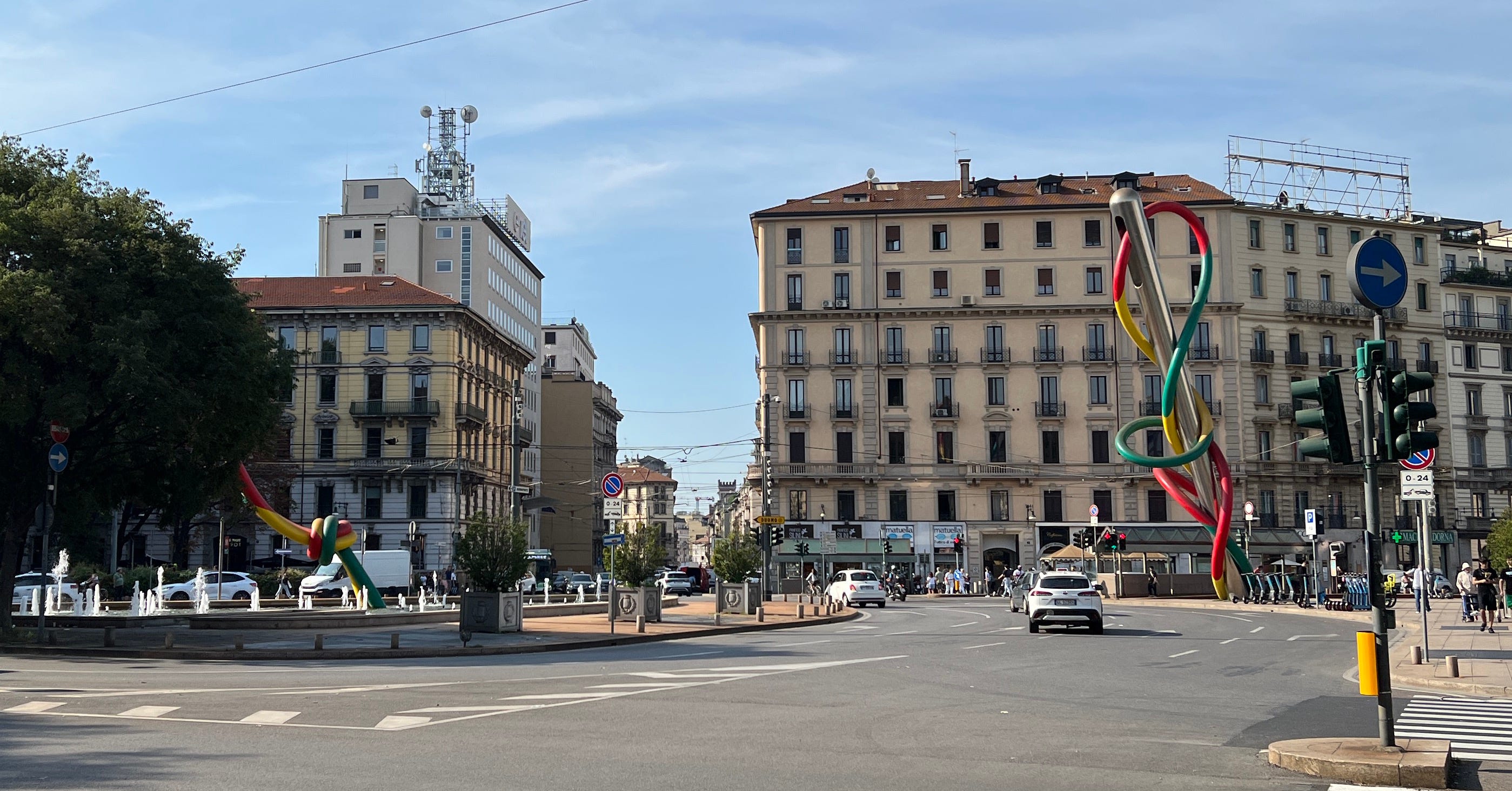
Jen: Yeah, and the piece is really kind of a nod to Milan’s fashion industry. And the thread colors actually represent Milan’s metro lines.
Greg: Yeah, it was very clear once he told us what it was. (laughs)
Jen: Right? (laughs)
Greg: But at first, we didn’t get it. However, it wasn’t far from that piazza to get to Castello Sforzesco.


Jen: So the castle is one of the largest citadels in Europe. It was originally built in the 1360s and it is spread out over a massive area. When I first heard that we were going to see this castle, I was like, “Oh great, another castle. Because we haven’t seen enough of those already…”
Both: (laughing)
Greg: Yeah, this one is very large and Corrado taught us a lot about how it was utilized, but I’m not going to claim that it was, like, the most impressive castle we had seen in Europe. There were a few interesting things, like, at one point he showed us the front entrance had these very massive drawbridges. You can still see some of the mechanics and the slots that were the anchor points.
Jen: Yeah, the main tower itself is actually a reconstruction because the original one was destroyed in 1521 when gunpowder that was stored inside exploded. There’s a little bit of urban legend as to what actually happened, but who really knows?
Greg: Yeah, I kind of like the idea of a whole spy and everything, but it’s probably not true. Another neat little factoid while we were there. So the Visconti family symbol includes a serpent swallowing a man. And the Visconti family are the ones that were the ruling family over Milan for a significant portion of time. And I believe they’re the family responsible for creating the citadel.
Well, in 1910, when Alfa Romeo was founded in Milan, they actually took that portion of the Visconti family symbol and used it as their corporate logo.
Jen: Yeah, and I really — for some reason — was super surprised that Alfa Romeo was founded in Milan. I guess just with the name, I thought it was founded in Rome. So that was a neat little fact to learn.
Greg: Yeah, Corrado did a really good job of making the whole tour really interesting. And I think it’s part of the reason that we both were so impressed with our time in Milan and we got so much more out of it than we expected.
Jen: Yeah.
Greg: From the castle, the next stop was to go walking through a somewhat famous neighborhood of Milan called the Brera District.


Jen: Right, and it’s really just several blocks of narrow cobblestone streets, but it’s considered the cultural heart of the city. And it’s home to the Palazzo Brera Complex, which houses the Pinacoteca Art Museum, the Academy of Fine Arts, a botanical garden, and a library that’s all under one roof.
Greg: Yeah, we’ll actually talk more about the Pinacoteca di Brera in the next update because we went there. It’s an art museum that’s very, very impressive in my opinion. But once we passed the Palazzo Brera, we next saw the Teatro alla Scala, which is one of the most famous opera houses in the world.
Jen: Yeah, and as we were passing by, Corrado kind of paused the group because he saw that the delivery doors on the side of the building were wide open. And that gave us a full view into the backstage area, which was really cool. And he gave us a little information about the sheer size of that backstage area compared to the rest of the building.
Greg: Yeah. He also described a lot more about the theater, but I really didn’t get much because I was so distracted trying to look —
Jen: (laughs)
Greg: — inside and see more of the stage area and backstage.
Jen: We were really kind of hoping to be able to go inside like we did in Vienna and maybe even see an opera while we were there in Milan, but the season didn’t start until early December, so sadly we missed out.
Greg: So, not coincidentally, the Teatro alla Scala has a piazza right across from it. And the Galleria Vittorio Emanuele II starts pretty much at that piazza, and it connects the Piazza del Duomo on the other side. So, as a part of the tour, Corrado takes you through the Galleria and gives you a bit of a lesson about what it is.
Jen: The Galleria is Italy’s oldest active shopping arcade, and it was built between 1865 and 1877. The people of Milan lovingly call it, il salotto di Milano, which means, “Milan’s living room.” And for the time we were there, it was kind of our living room too, because our hotel was located in the Galleria.
Greg: Which was interesting because while people were catching a lot of things we already had noticed, we could pay more attention to Corrado than I did when I was — (laughs)
Jen: (laughs)
Greg: — at the Opera House. But it was really neat that he pointed out a lot of things like the floor mosaics.
Jen: The floors have just these tile mosaics that are really cool. And in the central octagon under the glass dome, there’s four coats of arms of the historic Italian capitals. So Rome’s she-wolf, Florence’s lily, Milan’s red cross, and Turin’s bull. And we found out that Turin is Milan’s rival city.
So one of the fun traditions in Milan is you place your heel on the Turin bull’s testicles and spin three times for good luck or fertility. You can tell that everybody takes up this tradition because it’s ground down literally inches below the rest of the tile from so many people doing this.
Greg: Yeah. Also, apparently it’s been repaired a time or two in the past and now they’ve just given up repairing it because it always gets ground back down very quickly.
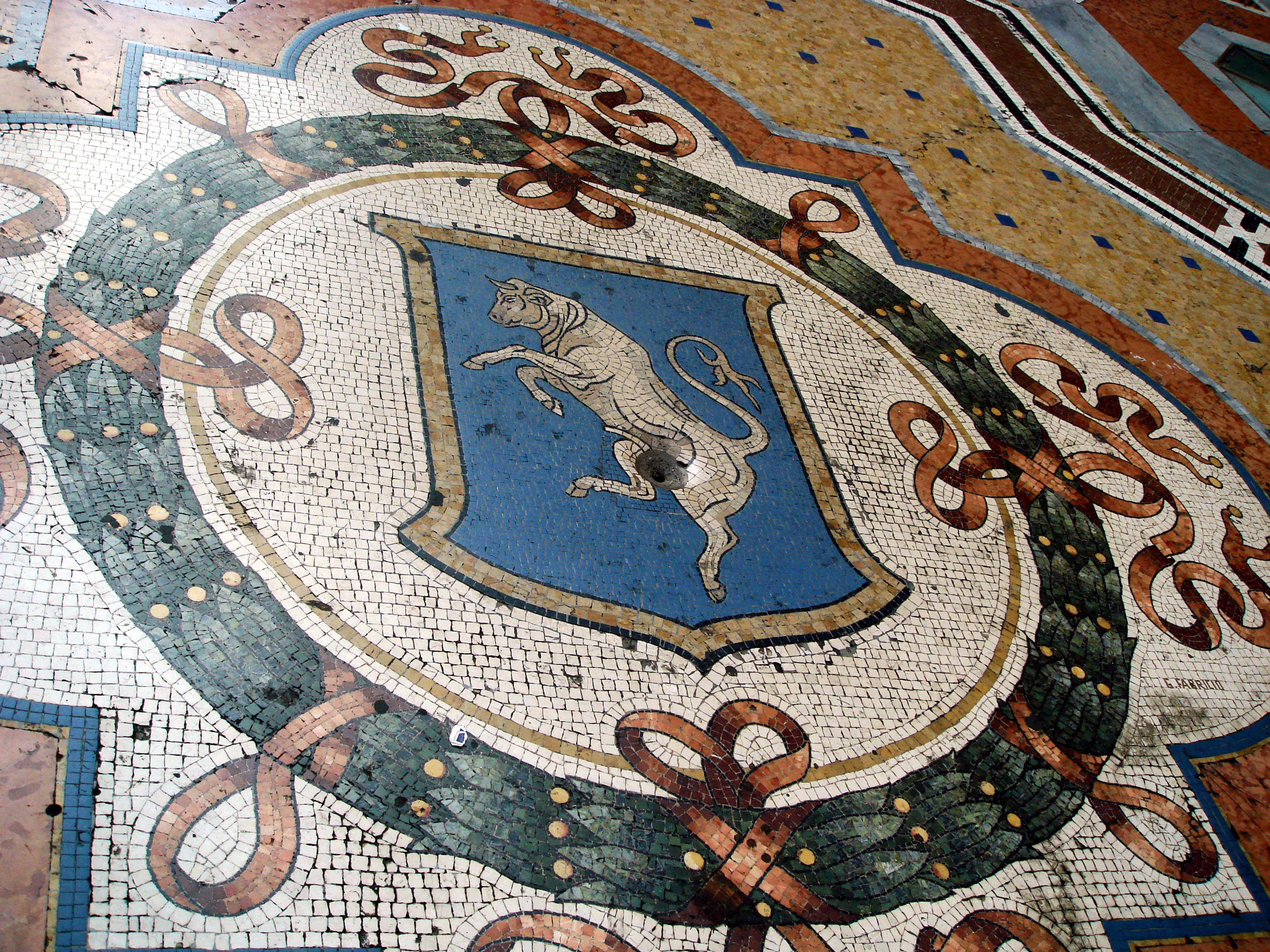
Jen: I think for most people, they didn’t really know about the tradition. They just saw everybody else wanting to do it and wanted to get it on an Instagram reel or a TikTok. So we did not wait in line to do that…
Greg: No.
So he taught us some other cool things about the Galleria that we had not learned before then, like, all of the shops are required to use the same gold lettering on black background.
Jen: Right. And apparently the very first Prada store that opened in 1913 is still operating in the Galleria with its original historic interiors. And a fun fact is there is another Prada store right down the way, but you can only get stuff with the original logo at the first Prada store.
Greg: Other than those few things, the main thing we took away from the Galleria is that you have to dodge people filming with their phones everywhere. And if you’re not dodging people with their phones recording everything, you have to dodge the smokers.
Jen: Yeah, I felt like we were in a game of Frogger sometimes, like, trying to get out of people’s photos, but not trying to hit the cigarette butt that (laughs) we were about to be burned with. It was kind of nerve wracking at times.
Greg: Yeah, I much preferred the Galleria when we were watching it from our balcony up above —
Jen: (laughing)
Greg: — rather than down in the…the trenches, as it were.
Jen: We’re more people watchers and not people minglers, I guess. (laughs)
Greg: Yeah, that’s probably accurate. Um, in any case, once he took us all the way through the Galleria, you end up in the Piazza del Duomo, which is right there at the big cathedral. As Jennifer said in the last update, you probably saw several times during the Winter Olympics.
Jen: Yeah, and it’s the largest church in Italy. St. Peter’s Basilica is technically larger, but it’s in Vatican City, so that doesn’t count.
Greg: Yeah. And the outside is extremely ornate. There’s over 3,400 statues. There’s 135 spires. Construction for Il Duomo began in 1386. The final details were not completed until 1965. So that was almost 600 years of construction.
Jen: As unbelievable as that might sound, hundreds of years is a common thread in the construction of European cathedrals.
Greg: Yeah.
Jen: To help you kind of imagine the size of this church, it can accommodate up to 40,000 people.
Greg: But the inside really was just as beautiful and massive as the outside.
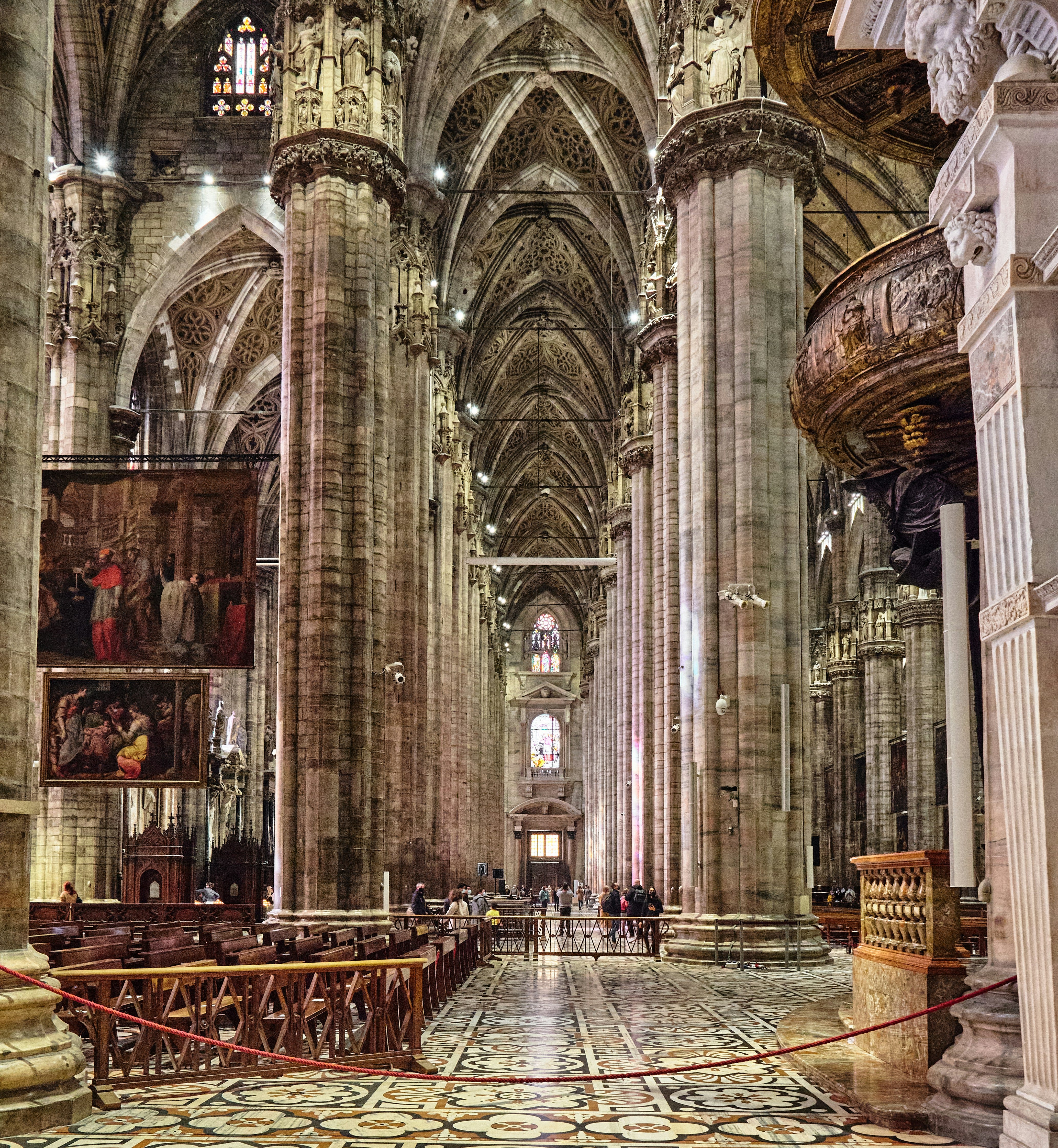
Jen: Right. But it was kind of darker than I expected it to be inside. Every other cathedral we had gone into in Europe was kind of built to flood with natural light through the stained glass, and the Duomo didn’t really have that.
Greg: Yeah. And while we were there, there were hundreds of people inside, like, at a minimum. And that kind of affected everything for our tour. Corrado did his best, but we had these, you know, earpiece systems so that we could hear what he was saying. But due to all of the people and almost all of them had these pieces, it was mostly just interference and feedback, even when you were right next to him.
Jen: Right. I felt kind of bad for him because it was almost like he was a little mother duck trying to keep all his little ducklings together. And there were about 20 other groups doing the same thing while we were there.
Greg: Yeah. So as a consequence, we didn’t really learn or retain too much of what he taught us about the inside of the church, but it was still really, really cool to walk around inside and see everything.
Jen: One thing though that did kind of stick out to us is the meridian sundial that’s there. It’s a brass line that runs across the floor and it starts near the entrance. It was installed in 1786 and the way it works is there’s a small hole high up on the south side of the church and sunlight enters through that hole and hits the brass strip at solar noon. And depending on what time of the year it is, it will highlight a zodiac sign in the marble that’s on either side of the line. And these zodiac symbols mark the seasons of the year. Feels really strange that this is on the floor of a Catholic church…
Greg: Yeah, because it’s not really part of the church. They didn’t decide to do that. The Habsburg government installed it when they were standardizing timekeeping across Milan. So astronomers helped design it and they used the zodiac calendar to basically mark the track of the sun’s position through the year.
Jen: Yeah. So having a zodiac calendar in the Catholic Church definitely seems odd, but it did serve a practical purpose, I guess.
Greg: So the tour ended inside Il Duomo. And as we broke up, Jennifer and I took a moment to approach Corrado and just let him know how much we appreciated him and to also kind of just tell him straight up he was hands down the best tour guide that we had.
Jen: Yeah, and it was kind of funny because he got a little emotional. And I mean, I think we even got a little (laughs) emotional telling him that. But come to find out, his background was he was a flight attendant for 28 years before he became a tour guide. And his parents were both teachers. And from an early age, they instilled a love of Italian art and architecture in him. And he felt very lucky to be able to share that with others.
Greg: Well, once we all parted ways, we noticed we were feeling a little bit hungry and there were a lot of people walking around us with these, like, calzone kinda looking things.
Jen: Yeah, I’ve kind of learned that there’s definitely one thing we take notice of is when people are carrying food around. (laughs)
Greg: (laughs in background)
Jen: And we really wanted to find out where these things came from. So we walked around a little bit and happened to stumble really right upon it. It’s a place called Luini’s.
The bakery itself dates back to 1888, but the Luini family took it over in 1949 and made it famous for panzerottis, which is what we saw people carrying around.
Greg: Yeah. So it was kind of like, uh, a calzone, a little bit smaller handheld, and you can get it baked or fried. We got two of them for six euro. And I just thought, number one, cost effective. Number two, delicious.
Jen: Right? So that was pretty much the end of our day. But while we’re talking about delicious food and cost effectiveness, we had dinner at a pizza place nearby and we were able to get two really big slices of pizza and two sodas for 15 euro.
So the takeaway from that is you don’t really have to spend a lot of money to eat well in Italy.
Greg: That’s true. Although…we did also spend a lot of money and eat really well while (laughs) we were in Italy.
Jen: That is definitely correct! (laughs)
Greg: Uh, in any case, this is probably a good point to stop this update. The next update, we’ll talk about our visit to the Pinacoteca di Brera, which, if you remember, we mentioned was the art museum in the Brera district.
Jen: Yeah, and this is a museum where I discovered one particular artist that got me way more interested in art than I ever had been before.
Greg: So, thanks for checking in.
Jen: And we’ll see you at the next stop!


