


Both: Hey everyone!
Jen: It’s Jen and Greg with an update on our travels.
Greg: This update will be the first of the time that we spent in Zurich. It’s another one of those locations that - it’s going to take us more than one update to cover it all.
Jen: Yeah, we went from Montenegro to Zurich because we wanted to experience the Swiss Alps before it got too cold because we didn’t have the proper clothing for snow and cold weather.
Greg: An interesting little fact about Zurich is it’s one of the happiest cities in the world. There is, uh, an organization in London that tracks the Happy City Index. And for 2025, Zurich ranked second happiest city in the world, just behind Copenhagen.
Jen: I can see that. It’s probably because Swiss people apparently consume about 22 pounds of chocolate per person per year.
Greg: Yeah. It’s tasty chocolate, too.
Jen: It is.
Greg: We flew into Zurich Airport, and like a lot of places in Europe, this really cool aspect of having a major passenger train station attached to the airport.
Jen: Yeah. It makes it really convenient, but getting to the trains themselves is a little bit of an adventure. So they make you go outside, like you’re going to pick up your baggage, but then you have to go back inside, then go up some stairs, like you’re leaving for the departures, to go back downstairs to get to the train platforms.
Greg: Yeah, it felt like being in one of those Escher paintings, where it seemed like no matter which way you walked, it was wrong.
Jen: Yeah, but we were following the sign, so it’s not like we were lost.
Greg: No. It was confusing.
Jen: Yeah.
Greg: But we got it figured out, and we got on our train. We had a changeover in Zürich Hauptbahnhof, which put us on a very easy line to understand for us to get to Thalwil where we were staying, which is right on Lake Zurich.
Jen: Yeah, the walk from the train station to the hotel was about a mile long, so for us at that time, it really wasn’t that bad, even with backpacks. Our hotel was called Alex Lake Zurich, and we checked in and they gave us the most terrific room with a view of the lake.
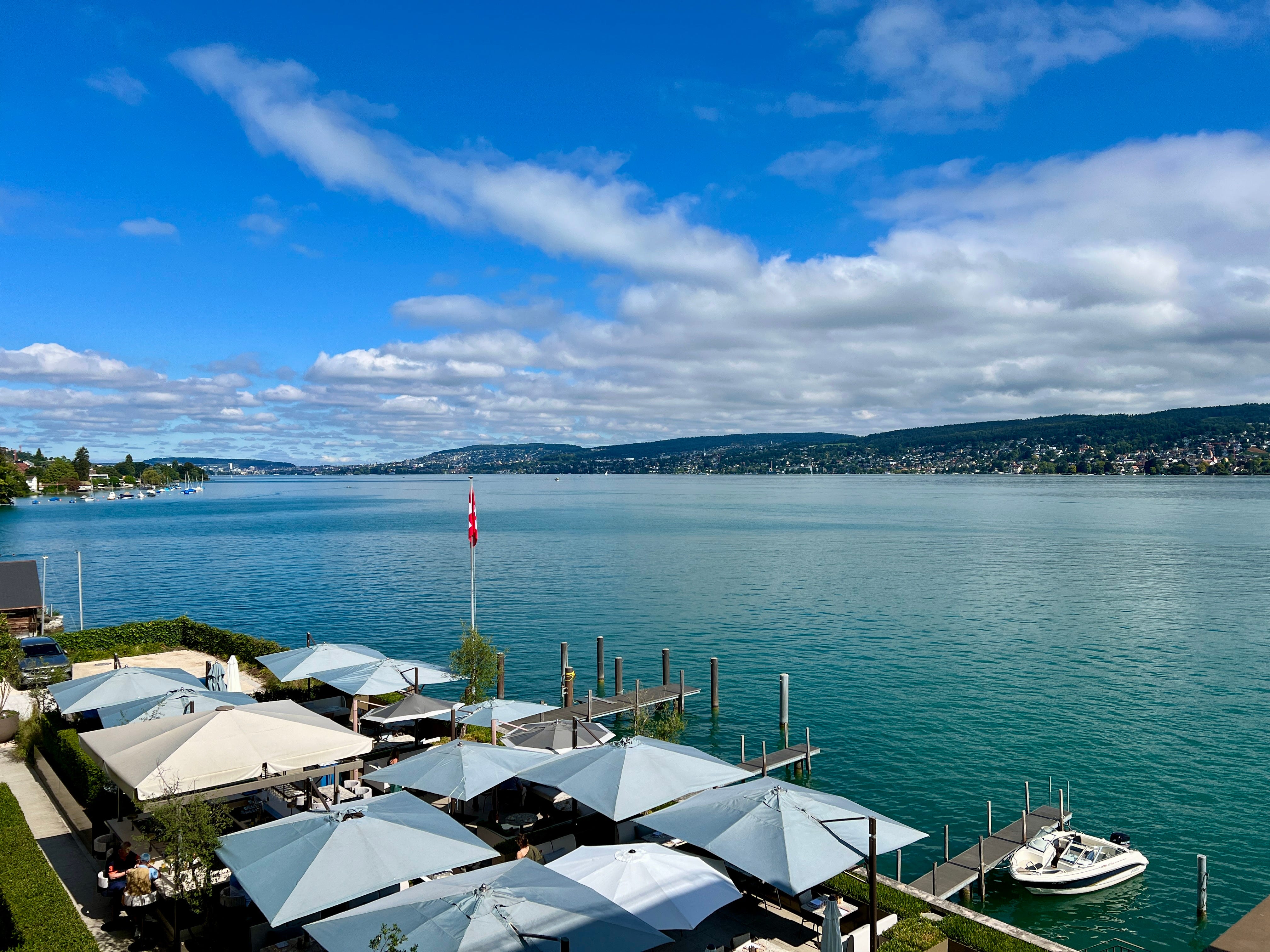
Greg: Yeah, overlooking the water, very beautiful. Plus all around Lake Zurich, very beautiful.
Jen: Yeah, I think it’s probably one of the prettiest lakes I’ve ever seen in my life.
Greg: After checking in, they showed us around, and one of the things that we saw was this hotel restaurant downstairs. We took a look at the menu and immediately became very happy because it was about fresh food and vegetables and lean proteins and fish, and we were very excited to get back to eating stuff like that.
Jen: Yeah, I got fish that was caught in the lake outside, and I have never looked forward to eating a salad more in my entire life.
Greg: Yeah, we also learned something about utensils while we were there.
Jen: (laughing) Yes. So — because it was a whole fish — they brought us this knife, which I have always thought was a butter knife. But no, there’s an entire knife for fish.
Greg: Yeah, it’s the one that’s very small and has, like, a drop down to this flat portion. That growing up, I was told was a butter knife, but it didn’t really make sense because there’s already the butter knife. Apparently that is for removing the skin from fish and we never knew it.
Jen: Yep. Learn something new every day.
Greg: Yeah.
Jen: So the highlight of this day was going to be our tour of the Lindt Headquarters in Zurich, which was in walking distance of our hotel.
Greg: Yeah, it’s one of the reasons we picked the hotel —
Jen: (laughs)
Greg: — if we’re being honest.
Jen: Yeah, so we decided to take a more leisurely pace and stop in one of the parks along the way so we could sit and enjoy the lake a little bit.
Greg: Yeah, it was a pretty nice little park, not a big one. But it’s right there on the lake, and it was us and two ladies who looked like they were just visiting while their dogs played together.
Jen: Yeah, this park was probably the site of one of our weirdest stories of the trip…
Greg: Yes, the weirdest story.
Jen: (laughs) So these two ladies that were there were talking and letting their dogs play. You know, there was a brunette lady, she had her dog. And a blonde lady that had her dog. We were further away sitting in the sun, just kind of enjoying the lake. And the brunette lady started walking back with her dog.
Greg: Yeah. So I’m talking to Jennifer about generally how amazing Switzerland appears to be —
Jen: (laughs)
Greg: —if you can afford it. And her face just sort of, like, perks up and her eyes get real big and she looks directly past me. So I turn in time to see the blonde woman who had stayed back by the water, her leg just kind of settling because she chose to lay down.
And I’m, like, “Why did this woman choose to lay down next to the water?”
Jen: Yeah, so she didn’t choose to lay down. She was sitting on this stone wall and fell over like a sack of potatoes. Like she just passed out. And we didn’t know how close to the water she was on the other side of that wall. So I kind of freaked out and I popped up and I’m going to walk over there.
Greg: Well, that’s what I’m sitting here going, “I need a grown up!”
Jen: (laughs)
Greg: So I start booking it towards the brunette woman with her dog going, “Ma’am, ma’am!”
Jen: And then I even start yelling at the lady, like, “Ma’am!” And we finally got her to understand, “Ma’am, your friend fell down.” And she kind of looked at us like we were crazy. Meanwhile, the blonde haired lady’s dog had run over and she said, “Oh, no, that’s her dog. She’s, she’s going to stay here.”
We’re, like, “No…she fell!” And it clicked at that moment for the brunette lady. And she was, “Oh, no!” And she got kind of frantic and started asking us to call the ambulance.
We don’t know what 911 is in Switzerland. So we told her that. Okay, well, she runs over there and “just hold my dog.” So I became a dog sitter for a day in Switzerland.
Greg: Yeah, and I’m a little bit sad to say, once that woman took over, and I’m kind of, like, feeling useless because I can’t do anything. I don’t speak Swiss German or Standard German, or I, and I don’t have a phone. I’m kind of just standing there, and then something in my brain clicked as…this might be a setup.
So now I’m on high alert. Did they realize that we were Americans from a distance and this is some kind of scam? So I’m just looking at Jennifer and I’m, like, “You keep that sling bag safe.”
And I’m like, wait, she can’t protect the sling bag —
Jen: (laughs)
Greg: — and hold the dog while the free dog is jumping all over the dog on the leash. So I’m, like, “Give me the dog on the leash.” It was…odd.
Jen: Yeah…chaotic as well.
And by that time, the brunette lady helped the blonde lady up. I don’t want to be mean about this, but she looked high when she got up. But it also could have been a medical episode. We have no idea what happened.
Greg: Yeah, I just find it strange if she were that high, the brunette woman would have noticed, and all of their posture and nonverbals that we could see at a distance, it seemed like a normal conversation between two friendly people.
Jen: Right. But she didn’t want us to call anybody for help. She didn’t want to call the doctor or anything like that. She said she was fine, and she lived a few blocks away from the park.
Greg: Which is what made us think it might have been drug related because why wouldn’t you want an ambulance if it was a medical episode?
Jen: Right. Once that all got settled, the brunette lady said, “I’ll walk her back to her apartment.” She took her dog back. And then we kind of felt bad. Like, are we letting this lady walk into an ambush at this stranger’s apartment? Because we still don’t know if they were friends for real or if they had just met in the park and had their dogs in common.
Greg: Right. So if it was a random encounter and now she’s walking with a stranger back to some random location, she might be in danger. But I’m still thinking we might be in danger. So I was, like, this woman seems to be in control and comfortable. Let’s let her do her thing. We need to start walking back to the area for the tour.
Jen: Yeah. I think we just watch too much TV.
Greg: Yeah, I do feel badly for having such a paranoid view of the situation. But, I mean, we’re in Europe and a lot of places warn you about how Americans get targeted, so I couldn’t help it.
Jen: But would that happen in the second happiest place in the world?
Greg: (laughs) Ha, right? Yeah.
Jen: So we decided to continue our walk towards the Lindt Headquarters, and that really only took us about three minutes. And we still had 20 minutes before our ticket time to let us in. So we found another park!
Greg: Yeah, this one was bigger. It was prettier. And there were a lot of people there doing the kind of thing you just think is like movie stuff and not real.
Jen: Yeah, like workers having their lunch on a park bench.
Greg: Yeah, couples walking around holding hands. It was… a little bit surreal.
Jen: Yeah, I was waiting on some musical moment to come up like, um, in Enchanted.
Greg: Yeah. (laughs)
Jen: (laughs)
Greg (singing) How will she know?
Jen: (laughs)
Greg: Anyway, it was a very lovely time in the park, even for just 15 minutes.
And then we went to the Lindt Headquarters. And the big thing that you notice when you are outside, but when you get close to the door and they open, you just hit with the aroma of the chocolate and you just can’t help but think, “This might be what heaven smells like!”
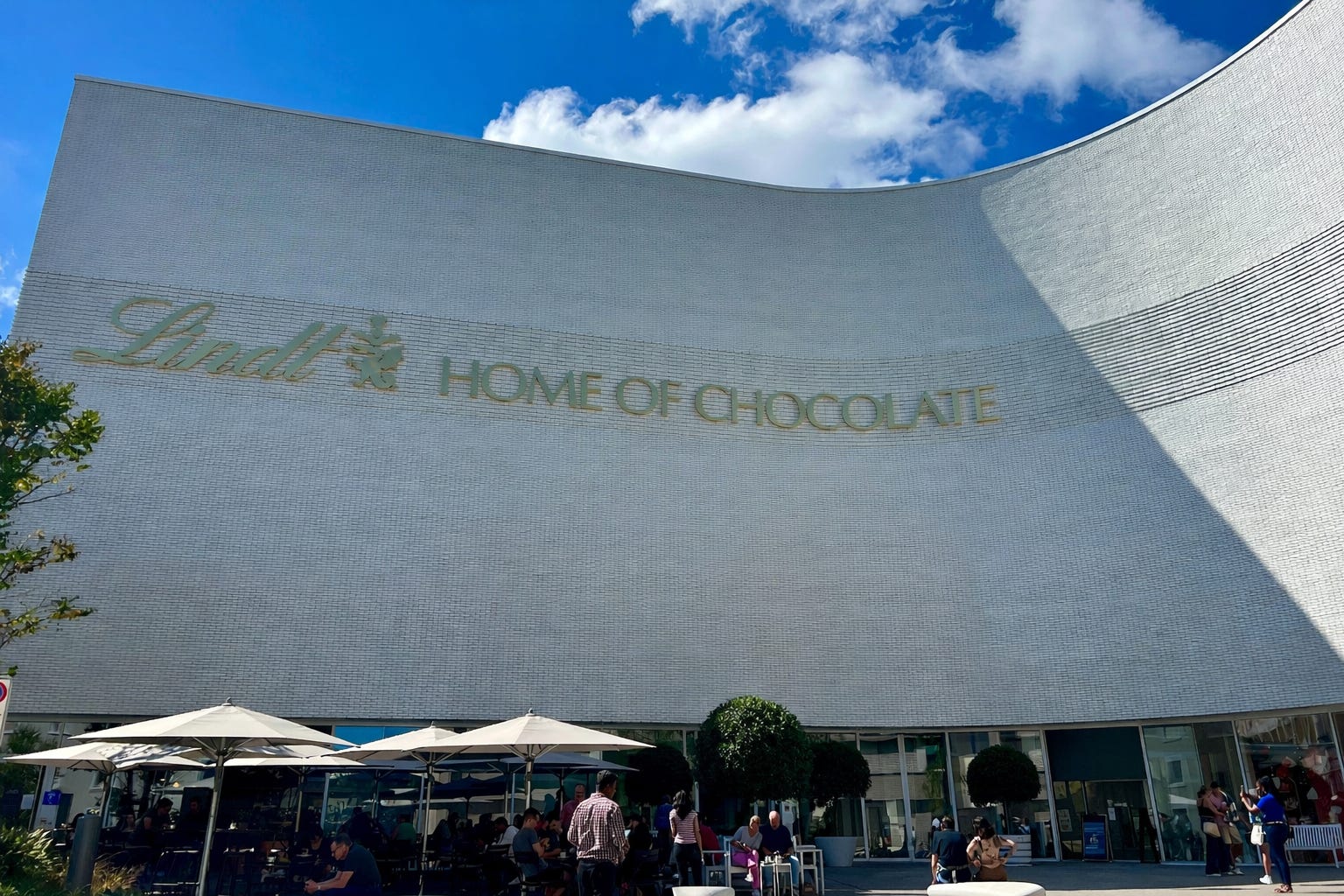
Jen: (laughs) I agree.
So the Lindt Chocolate Company is actually a global brand. And you’re probably most familiar with its truffles that are in brightly colored wrappers. They come in assorted flavors. But it was actually started in Switzerland by a man named Rodolphe Lindt.
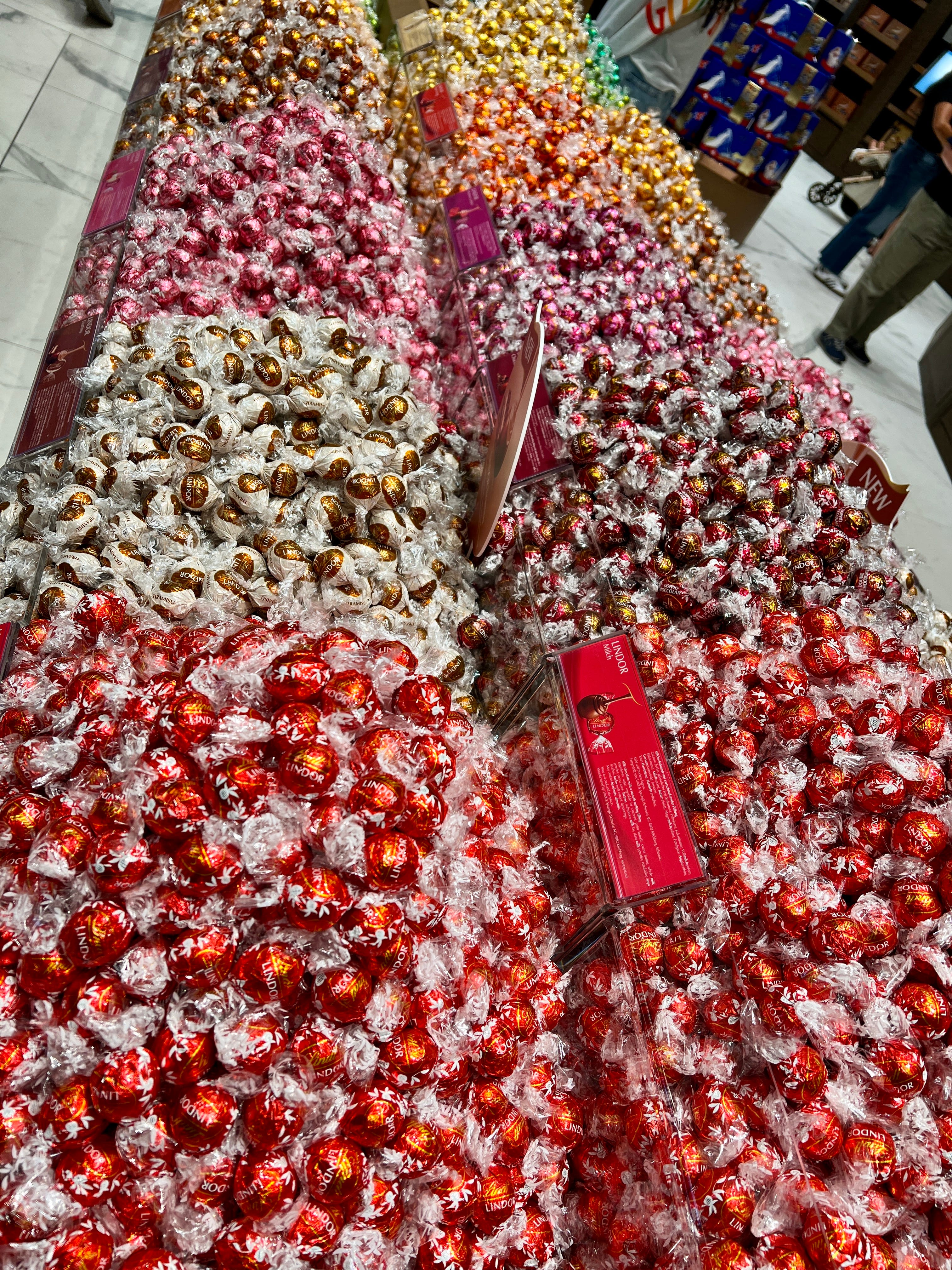
Greg: Yeah, and apparently his contribution to chocolate making was an accident. In 1879, he left his little chocolate shop and forgot to turn off his mixing machine. So when he got back on Monday, it had been stirring for three straight days, and it produced a smooth chocolate that he had never experienced before and everyone seemed to really like.
Jen: So the first thing you see when you walk into this great big welcome area of this chocolate factory is this huge fountain…what you think is made of chocolate, but it’s not really.
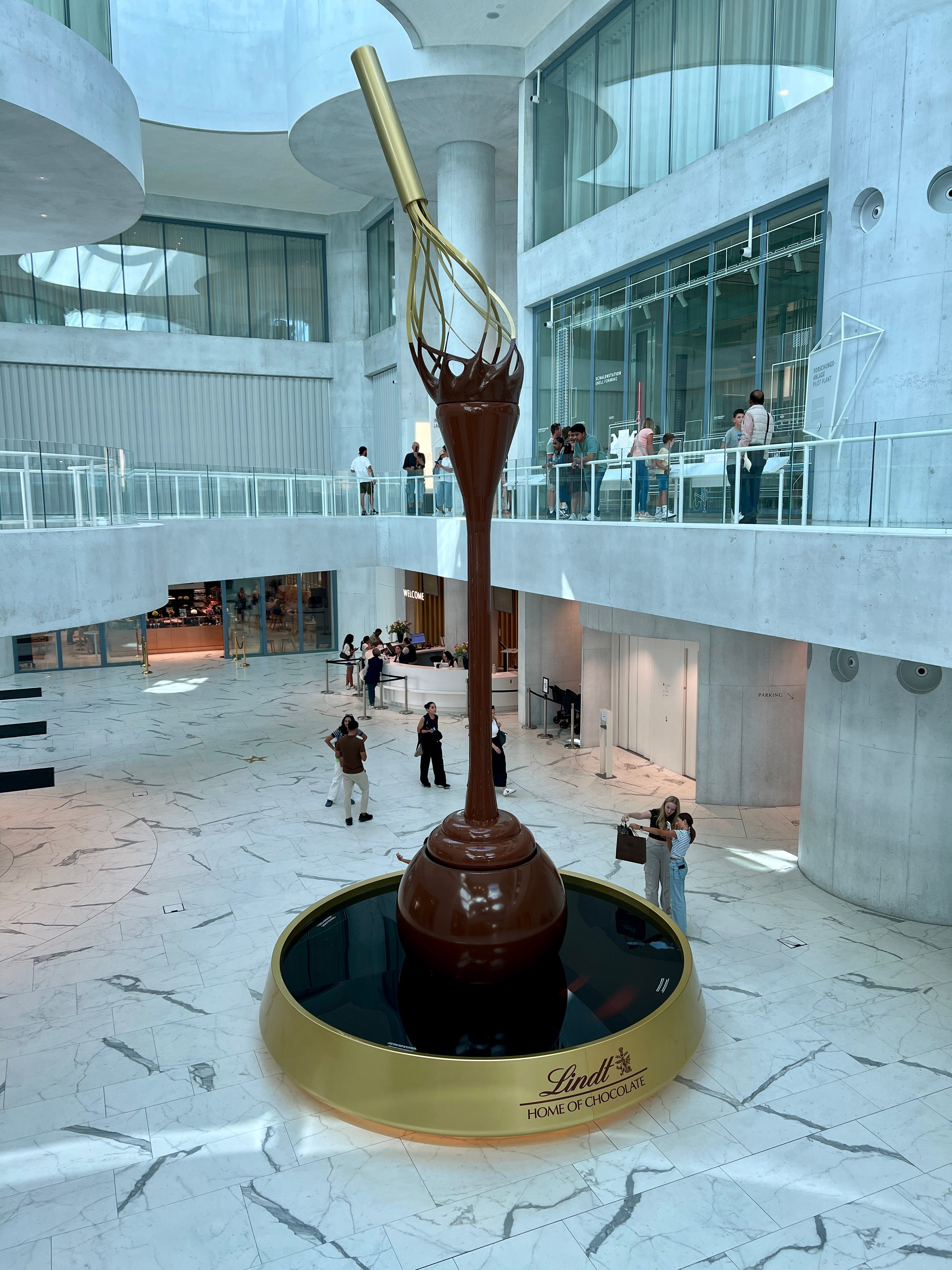
Greg: No. And I tried to explain to Jennifer before we got there because we had a very…heated discussion.
Jen: It was spirited.
Greg: She was convinced it would be all chocolate pouring out of this thing at the top ceiling structure into this lower fountain area. First of all, the amount of chocolate they would be pumping up and down for that fountain. Secondly, people are gross. They would put their hands in there. They would spit in there. They might even pee in there. I don’t know. You can’t have it. It’s just not appropriate.
Jen: So Greg was thinking we were, like, going to fall into the Oompa-Loompa chocolate factory and we can’t use any of that chocolate anymore. Health Department Greg…
Greg: Right. But Jennifer was convinced it’s not the chocolate they use to make the candies. It can be whatever they want.
Well, guess what? When we got there, it is a big piece of, like, plastic painted to look like chocolate with little pieces of chocolate that roll down it.
Jen: But it smelled so good.
Greg: And I will admit, for all of my pessimism and concern, I was disappointed that it was not all chocolate.
Jen: (laughs) So after we took all of our pictures of the fountain, it was time to take our self-guided tour. And we grabbed our audio guide from the base of these stairs and stood in a long line waiting to get in.
Greg: It’s also not the smartest design because the first thing you do is walk into a very small, narrow room, which has a lot of decorations made to feel like you’re in a jungle where they’re trying to grow the cacao plants.
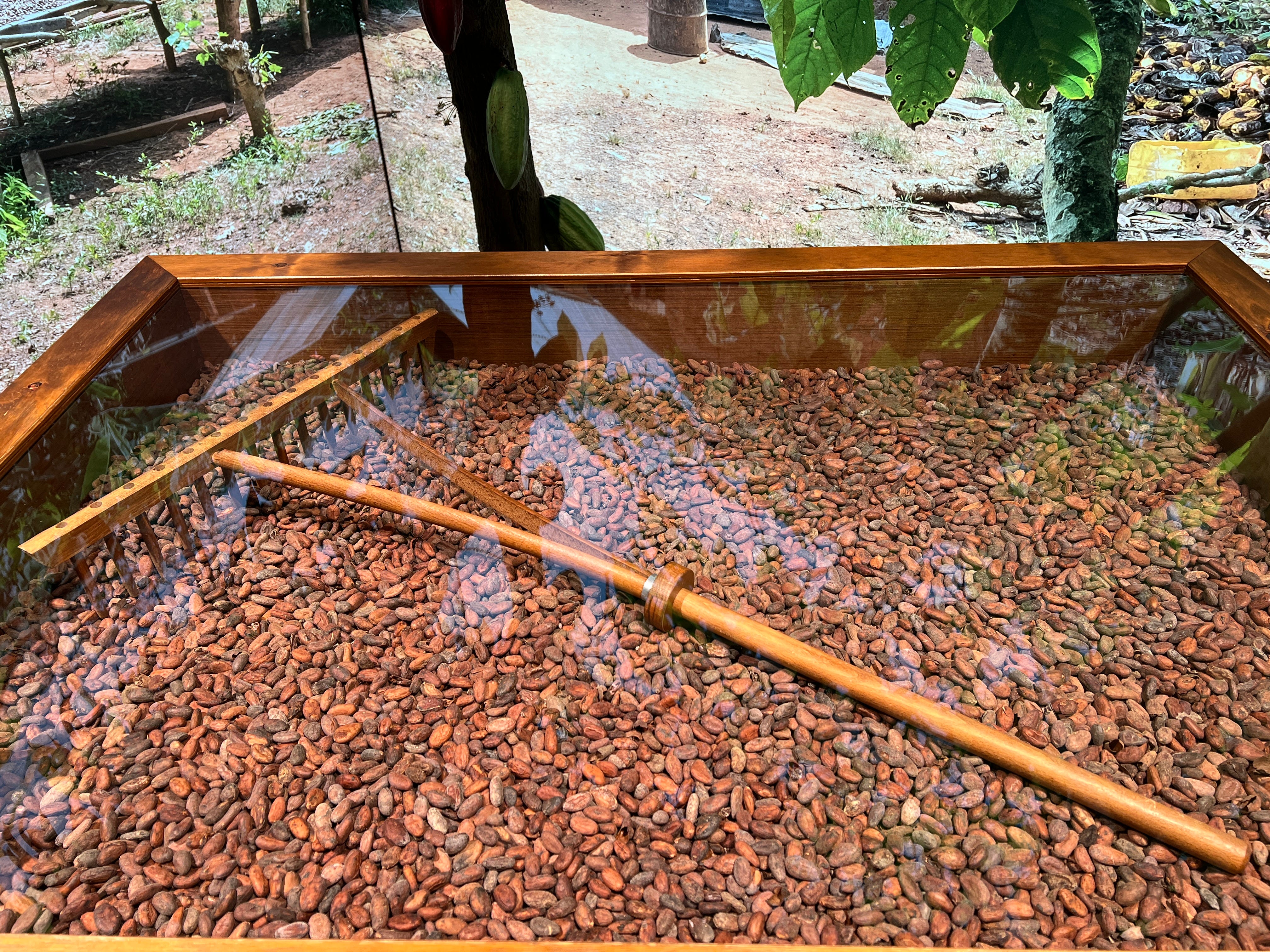
And there’s spots for you to listen to your audio guide, and they talk for anywhere from 45 to 60 seconds. But there’s one and then about 10 feet later, there’s another one. And so people walk in, they scan and block the entrance. Other people can’t walk in. And then they go 10 feet more and scan and wait again for another one minute long talk on the audio guide.
Jen: And that’s the ones that could get it to work the first time they scanned it. Because we had the same problem with that scanning issue as we went down the hallway. And it’s on both sides of the room, so you have displays on both sides. So there’s no clear path to get through to the other side.
Greg: Right. And there’s so many spots and everybody wants to scan their audio guide. And like Jennifer said, a lot of people didn’t know how to get them to work. So it was difficult to see everything that you had to see. You’re in this crowd of people and you really shouldn’t be so stuffed up at the very front of the museum. I don’t know why they designed it that way.
Jen: Yeah, but we finally made it to the end. And then we go into this other room that kind of gives you the history of when it came from Central America and slowly made its way to Europe.
Greg: Also, they talked about the social impact of having chocolate and drinking chocolate because that’s what it was in the beginning was mostly just a drink like hot chocolate.
Jen: Yeah, so that part was all really cool. Still got a little backed up because there were a lot of long audio guide snippets of information.
Greg: Well, and also at this point, we had begun changing our behavior, and we weren’t the only ones, of basically skipping many of the audio guides because so many people were around them or because, you know, the crowd being what it was, you wanted to get ahead of it.
And eventually, I would say halfway through the museum, we — and many other people — had just given up on the audio guides altogether because the placards that are near each section had a description that was often good enough.
Jen: Yeah, I agree. So the next room was a really fun room, at least for some of us.
Greg: Yeah, no, I was really stressed out in the next room.
Jen: (laughs) So this room had these big dispensers of chocolate that you could pull and sample each one with a little plastic spoon. You know, you get your sample of chocolate, you eat it, you throw your spoon away.
Greg: Yeah…that’s not what people did. And it really, really bothered me. We swapped out our spoons so the beautiful, smooth chocolate hits your spoon and it’s still a little bit warm and you taste it and then you see some grubby little kid with his cold virus or some old person who’s probably got COVID literally uses the same spoon that was in their mouth and they put it not under, not where there’s a, a gap of air. No! They jam it all up on it. So now their germs are all over that dispenser. It’s gross.


Jen: So needless to say, we didn’t spend too much time at those things. But towards the back of the room, there was another area that gave away, like, pieces of bars of chocolate. And they had different flavors in them like orange or, you know, hazelnut, those kind of things.
Greg: Well, it was intended for you to put your hand under it. It registers and drops a piece of chocolate bar into your hand. The problem became some people were treating it like it acts much quicker than it does. They put their hand, it wouldn’t drop. They would take their hand out, and then the chocolate would fall.
Jen: Yeah, so it was like a little hand sanitizer thing. That’s what people thought it was. I really think we ought to have these in our homes everywhere. Like, wave your hand under a thing, it gives you some chocolate...
Greg: Yeah, well, the first piece that I got actually ended up on the floor because I saw what was happening. And so I put my hand and left it until the chocolate dropped. But it dropped it with force that made it bounce off of my hand and hit the floor. And I wasn’t going to eat floor chocolate.
Jen: Yeah, so this is probably the chocolate that was made from the chocolate in the fountain that people put their grubby hands in, so…
Greg: (groans)
Jen: (laughs)
Greg: Aw, you don’t need to say that. Ohhhh, but you know what? I survived.
Jen: Yep, we are still here.
So after we got our fill of chocolate and our blood sugar was a little off, (laughs) we decided to walk through to the other rooms in the tour. The next one we went in was this room with this huge globe on the wall that kind of lit up when you touched a certain point and it showed you the world’s consumption of chocolate. So that was kind of neat you could see that.
And then you go into this next room that it was almost like the yodeler game from The Price is Right, where everything was like a miniature model of Switzerland. So you had little villages and you had a mountain with a hiker going up it. Just kind of showing you the Swiss production of chocolate and where different things came from.
Greg: Yeah, I think the point of that room was to teach everybody just how many chocolate companies Switzerland used to have, because you learned about companies you’ve never heard of who started in the late 19th century and maybe went out of business before 1910. And then also it had big companies like Nestlé or Lindt or whatever.
So it was really interesting as a room. Plus, a lot of people were taking pictures because of all of the, the miniature models. It felt kind of like you were Godzilla next to the Swiss village.
Jen: (laughs)
Greg: But, um, it was a neat room. The next room was also very interesting because it was like they had a time capsule of memorabilia from early 20th century and then like post-World War I and early, uh, 20th century up to World War II. And then in the ‘50s and the ‘60s, things like logo differences or, uh, tools that were used. It was really neat.
Jen: Yeah, I think one of the coolest things that we saw was, like, the molds that they used to make the chocolate bars way back when. They had some of those set out.
So we had one more room to go through. And this was probably my favorite room of all where they give you samples of the truffles. Now, granted, we have probably tried all of the flavors of truffles that they had, but we still were able to take one of each flavor for each of us. And they had persons on each end supervising to make sure you only took one a piece.
Greg: Yeah, but I felt singled out. They made for sure I was only taking one sample from each flavor. But people were walking up right in front of me and behind me, just jamming their hand in there and taking two, three, four of each one. Didn’t say anything to them, but they sure told me, “only one per.”
Jen: So Greg feels profiled.
Greg: I do!
Jen: (laughs) So I didn’t know how we were going to carry all of these truffles because they didn’t have a bag. But then I said, “Oh, I have a sling bag!”
And it was empty that day for the most part. It does fit 16 truffles, if you’re curious. Some of them did not make it all the way back. But my goal for the day was how to get these things to not melt.
Greg: Well, after you get out of that room, you walk past an area where they have sort of a smaller demonstration version of the automation that they have in their modern factory. And it was really cool to see just how they do a lot of what they do.
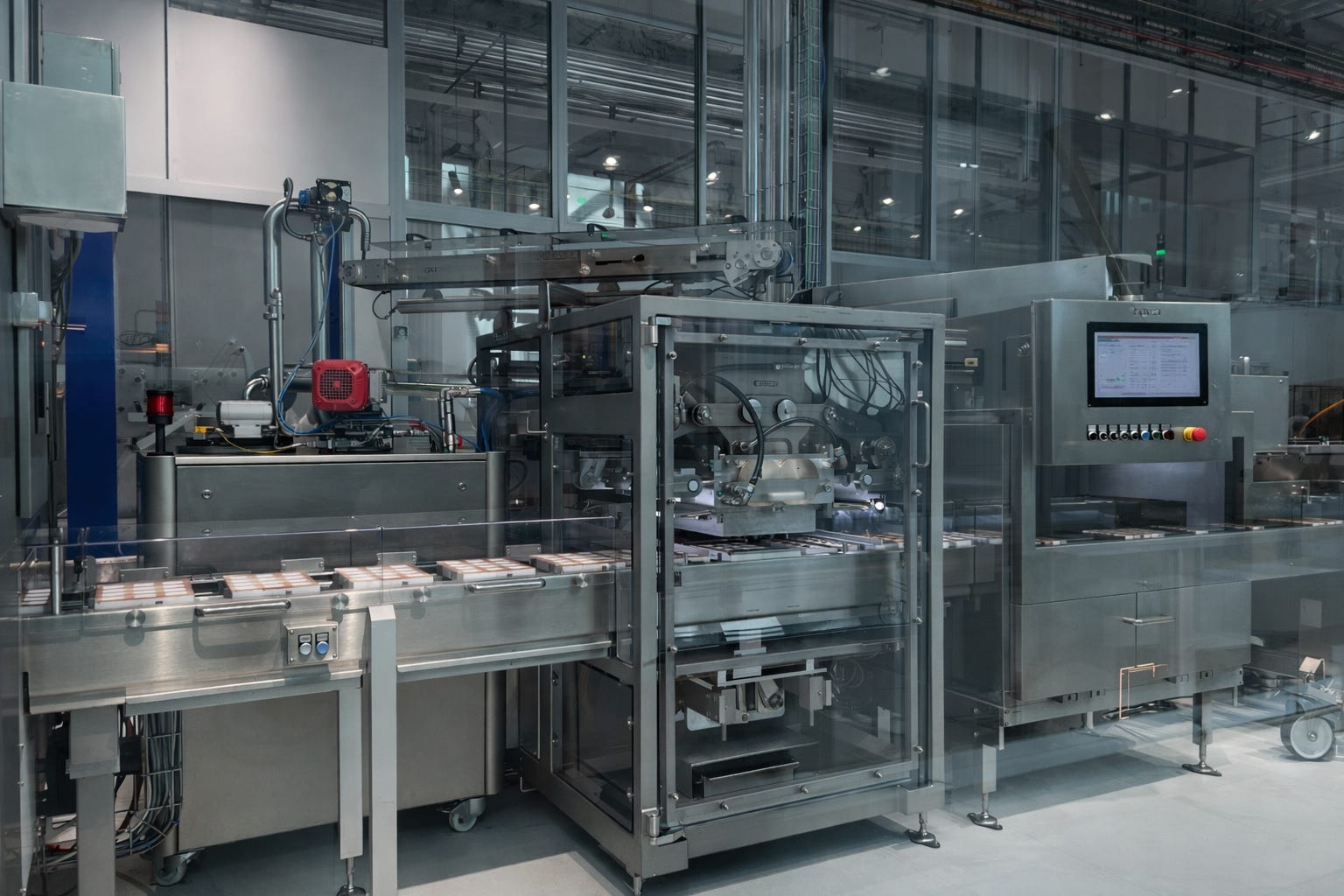
Jen: Yeah, so you see this all there on display, and then you see this really long line. Turned out it was a huge Rube Goldberg machine that gives you a sample of chocolate.
Greg: Yeah. And again, I was profiled. So you scan your entry ticket to the museum in order to get this big machine to do what it does. And it goes through the machinations and drops you your sample.
Well, the line is so long and they want to keep it moving that there are employees with boxes that are, like, “If you don’t want to wait, we have samples. You can pick one.”
So people are just going up and picking samples. I get up there and the lady’s, like, “Well, I need to see your museum ticket.”
Jen: (laughs)
Greg: You didn’t ask that person?!
Jen: So we didn’t wait in line, obviously, because it was really just all for Instagram. It was if you wanted to get a cool Instagram reel or something like that.
Greg: So that’s pretty much our experience at the Lindt Headquarters Chocolate Factory Museum. And we walked back to the hotel, a nice walk.
Jen: Yeah.
Greg: We even stopped again at a different park. I think literally three parks along the way, we stopped at each of them. And, uh, we hung out in the hotel.
But we also realized, again we had been walking so much during our trip around Europe that Jennifer looked and we had walked almost eight miles that day and we didn’t even notice.

Jen: No, I wish I still felt like that.
Greg: Huh, yeah.
Jen: (laughs)
Greg: So the next update will also be Zurich, but we’re going to talk about how we walked around the city itself.
Jen: Yeah, we had our own little city tour that we had made up and we didn’t pay any attention to when things were open.
Greg: Right. So some disappointment.
Jen: Yeah.
Greg: However, we also did a ferry ride on Lake Zurich to get back to the hotel, which was very nice.
Jen: Yes. There is nothing better than a good boat ride.
Greg: Ha! Indeed. So thanks for checking in.
Jen: And we’ll see you at the next stop!


